I wasn’t particularly interested in the life of Hans
Bezuidenhout at the time. Remember, he was Freek Bezuidenhout’s older brother
who had sworn revenge over the grave of his brother. The same Hans who insulted
my great-great-great-great grandfather Frans Labuscagne and Great Willem
Prinsloo at the funeral when they showed their disinclination to rebel against
the British occupation. The Oracle had
told me about him, however. And Barry and Ernest Pringle had also told me about
him. In fact, it seemed that everyone I talked to felt that I should make a
point of visiting his grave.

There was another reason. His monument was on my way home,
and I had passed it several times over the past ten years without seeing it.
The final reason was that although his role in the Slagtersnek rebellion is
adequately described in history, the exact places where it had all taken place
were ill-defined. The places were usually called by their original Dutch names.
Many of these names no longer existed, since they were replaced by Scottish
settler names. I felt that it would be a historical contribution if I were to
find and mark these sites with GPS coordinates so that other historians could
pinpoint them exactly.

And so I left Braeside and retraced my steps a few miles.
They told me I had driven past the monument where it stands against a
mountainside near some poplars where the road crossed the Sakrivier. Those were
practically the only directions I could get from everyone. It wasn’t much, but
I was resolved to try.

After a while “just a few miles up the road,” started to
feel like I was on the wrong road. I reached the Tarka/Bedfort/Cookhouse
junction and stopped. I took the Tarka road, and then turned around less than a
mile further. It instinctively felt wrong. There was a farmhouse by the
junction, and the signboard said “Mickey Doo,” but I couldn’t see a sign of
life so that I could enquire. I thought about turning left again, but I had
already been there twice. I was certain turning right was wrong, but I went
there anyway. At least this was the only stretch of road that I hadn’t been on
the previous day.
I meet Scott of the Karoo
The scenery was charming, but I felt ill at ease with my
direction of travel. After a goodly distance I began to drive more slowly, so
that I could think faster. I felt I must have missed a clue somewhere. Then, in
the distance I saw a thin line of dust appearing. It looked like a toy
locomotive on a track. I could see that it was a man on a motorcycle, which I
found strange, because you don’t encounter much traffic around these parts, and
I don’t think I’d ever seen a bike here before. It was more than just a man on
a motorbike, however. It was actually a dog on a motorbike with on the back.
Well, in my romantic imagination that is how it seemed to be. The Jack Russell
terrier on the petrol tank, with ears flapping in the wind, while its owner did
the driving.

As he approached, I saw him slow down, so I did likewise.
When I lifted my flipper in salute, I could see that the gentleman wanted to
have a talk with the stranger with the outlandish license plate. I think he
asked me whether I was lost or something. I forced a dignified expression and
began to explain my quest. At hearing the name of Hans Bezuidenhout, the ruddy
face cracked a smile and extended a hand of welcome.
“Chappy Scott’s the name” he said. “I live right back
there.”
He motioned with his thumb across his shoulder to a farm which seemed to be half-hidden amongst some brilliant green trees up the road. I smiled back and met his grip.
He motioned with his thumb across his shoulder to a farm which seemed to be half-hidden amongst some brilliant green trees up the road. I smiled back and met his grip.
“Herman Labuschagne,” I grinned back. “All the way from
George.”
In his eyes I could see at once that I had just met an
interesting man, and that he was interested in my quest as well. But first
there was the matter of protocol and pleasantries. If you haven’t grown up in
the country you wouldn’t understand. The object when two total strangers meet
is always to first attempt to establish common ground. You explain who you are,
you explain where you come from. Then you explain where you are going to. Those
are the base essentials. If you really want to score points, however, you
should now see if you have any kin in common. If you do, you make an instant
transition from being regarded as a “potential friend,” to being so to speak a
“ long lost brother.”

I knew this of course, and so I deliberately ventured: “My
people lived here before the Great Trek, and they were involved in the
Slagtersnek rebellion. I’m on a journey to trace their footsteps.”
From Chappie’s expression I could tell that I had spoken the
magic words. We weren’t exactly family, but sharing common roots in this spot
of wilderness counted as practically the same thing. I knew that all the
strangeness was now something of the past.
Chappie wasted no time in starting to tell me what he knew
about the history of the region. He told me his farm still had an old water
powered mill which was used in olden times to grind flour for the local
farmers. He himself, he explained, has been a professional hunter since the
1960’s. He seemed to have travelled the whole world over the years, and had
been to the United States a great many times. He had even once partaken of a
dog sled race across Canada, he said. Chappy also told me that I was lucky to
have run into him, as he is not often home. I found it strange to think that a
man like him in a place like this could be such a citizen of the world at
large. But I forget how much the earth has shrunk.
When I told my mother about him a week later, she immediately
smiled and said: “Oh I remember Chappy! We always used to see him at the
Professional Hunter’s Association banquets in Sun City.” Later still, one of my
business partner’s saw his picture on my Facebook page, and expressed with
astonishment that he knew Chappie too. Chappie used to be a friend of his late
father. Many people will know Chappie as the celebrated “Scott from Africa” who
also operates a professional hunting school. His website is www.scottofafrica.co.za

This left me quite astonished. We had no modern ties with
the Winterberg at all, and I would have wagered money that no-one there would
have had a chance of knowing anyone that I knew. And yet, it was certain now
that my father and Chappy must have met on many occasions.
A big cattle truck with a trailer passed us and went
rumbling up the mountain road, leaving us full of dust.
While we talked, an SUV pulled up and a lady rolled the
window down to squawk: “You look slightly lost.”
Chappy laughed, and said something like, “you reckon?”
I listened to two neighbours talking and enjoyed observing
how people still had time for one another in the deep countryside.
I looked at what I had written in my journal beneath the
blue wisteria that morning.
“There is a sense of
timelessness here,” I had written.
“Life feels colonial. It feels as if Nelson Mandela is still in jail on Robben
Island for no-one looks down, servants seem respectful and people appear to
have money. Not oceans of it, but certainly enough to live dignified and
gracefully. I look at how these people live and I feel we’ve lost something. I
keep trying to think what it is, but ultimately I think it is ourselves…”

After a while Chappy told me to follow me as he would go and
show me the site of Hans Bezuidenhout’s grave. And so off we went, Chappy on
his motorbike, with the dog on the petrol tank standing with his nose in the
air and his ears flapping merrily. I trailed behind, feeling out of place, yet
totally at home in this strangely familiar world. When we finally found
Bezuidenhout’s grave, it was roughly where I had thought it should have been,
but unlike at least two people had told me, you can practically not see it from
the road. Perhaps if you knew exactly where to look, but to the eye of a
passing stranger it was certainly invisible.

Chappy draw the fence wires apart for me so I could step
through, and then I did the same for him. This too, is country protocol. These
were the things you know simply for having been born there, for no-one teaches
you how to behave like country folk, except time and observation. Another sign
which silently distinguishes country folk from new intruders, is the way that
country people have of holding branches and gently letting them go behind them
when you file along a brush-lined trail. Townsfolk are not even aware of it,
but they invariably pass and let the branches sweep back to hit the guy behind
them in the face. So there are a dozen or a hundred little things that together
combine to separate people who are in touch with the land from those who simply
exist upon it.

We enjoyed the view, and Chappy told me about Bushman
paintings in the cliffs. That’s another country characteristic, peculiar to
modern times. We know that when you’re told where Bushman paintings are, you
don’t reveal it in public. This is information that country folk share with
country folk alone, lest the city folk should come to take their pictures, and
spray Coka Cola on the precious drawings so that the pictures would look
better.

I get to meet the Philips
family
By the time Chappy wished me well and turned back to his
farm, I had scribbled notes about several places and pictures down the road to
Tarka which he suggested I should see. My schedule did not include more stops,
but I was tempted to cheat a bit by lingering a little longer. And so when I
drove on, I could not help myself. I had to turn in at the old stone house of
Malcolm Philips. Chappie said he might know a thing or two, and he could give
me directions to someone down the road who also knew a lot about the local history.
I would thank Scott of the Karoo afterwards for this good suggestion.
If you’re used to country ways, you could have predicted
what happened next. I introduced myself to Malcolm’s son. He said to come with
him as he was sure his dad would like to meet me. That’s how I met Malcolm.
Malcolm insisted I should come in for tea. There he introduced me to his wife,
and together they introduced me to Willem, a boy who was spending the holidays
with them on the farm.
We exchanged the usual country talk, which meant that within
ten minutes it felt like we’d known each other all our lives. Malcolm’s son
showed me his guns, and we talked about farming and hunting and the “bloody
drought” that seemed to last forever. Malcolm told me how his father had lost
his family farm in a drought of many years ago. He returned eventually and
bought it back, as well as the farm next door. But times had not always been so
bad. There also were some good years.

Consider, for example, the celebrated wool boom years, when
all the sheep farmers had earned large profits. Such were the good times during
which Malcolm’s beautiful old sandstone house had been built. Those where the
years when wool fetched “a pound-a-pound,” or one pound sterling for each pound
of wool. Wool was so expensive in these times, my grandmother once told me,
that they used to walk along the barbed wire fences to collect even the barbs
of wool upon the barbs. Malcolm smiled when I told him my story and nodded
cheerfully. “That’s exactly how it was!” he confirmed.
As is the custom in the country, when it is meal-time,
people invite visitors to join in. Even when they weren’t expected. Custom
dictates that the stranger should protest and say that he would rather not, and
fumble some excuse. Then the host is supposed to respond with, “nonsense! I
won’t hear a word of it. You’re going to join us for a meal, provided that you
don’t mind that it is just something simple.”
I have been part of the phoney modern world for long enough
to feel a little uncomfortable to be imposing on people’s hospitality like
this, but at the same time declining an invitation can be precariously close to
insulting one’s host. Malcolm wanted to show me Hans Bezuidenhout’s monument
again, plus a few other things, however, and he wanted to have lunch first.
This it came that I had to join the family in the kitchen for a splendid
country meal.
Malcolm had a universe of breathtaking country stories to
share. There was, for instance, the story of horse trainer who used to work for
his grandfather. He was an Irishman named John Towers. This man was so
reclusive that he only went to town twice a year. When he did, he would not
ride his horse. Instead, he used to lead the animal on foot so that he could
roll away every sharp stone in the road which he thought might injure the
hooves of his beloved beast.
The curious thing about the Irishman was that when in town,
he would invariable go on a binge of epic proportions. By Monday he would be so
drunk that he could no longer walk, and had to ride back to his farm draped
across his patient horse like a wet rag. By then the horse would simply have to
find his own way across the jagged stones.
People loved their horses in those years. Malcolm’s
grandfather, he told us, would sometimes amuse everyone by riding his
magnificent stallion into his grand stone house. Fortunately the house was more
than big enough. The passage alone, seemed almost big enough to me to
accommodate a small car.
To illustrate how confusing the matter of farm names had
become over time, Malcolm told me that his farm is called Arendsberg on the
title deed. It was, however, known as Klipheuwel by the locals. Within living
memory, however, that had changed to Oxford. This is not the only example. It
is no wonder, therefore, that historical places have become hard to find along
these parts. Malcom said his grandfather had bought the farm from an old
Voortrekker for the price of a trek waggon and a span of oxen, plus a few sheep
and a bit of cash. That seemed expensive to me. Many of the Voortrekkers simply
gave their farms away to their British neighbours. Or abandoned them. Or as in
the case of the splendid Murray farm near Graaff-Reinet – traded it for a large
cast iron cooking pot.

Visiting the old De Witt farm
After lunch we tumbled into Malcolm’s pickup and set out on
my tour. I felt vaguely guilty at having clearly taken over the family’s whole
day, but everyone seemed cheerful and excited about the outing, which set me
more at ease. I wanted to return to the Bezuidenhout grave, but Malcolm wanted
me to see other things. I was in no position to make demands.

Time and experience had taught me that there is within
country folk a deep rooted desire to share the memories that they are the
custodians of. It is not as if they merely want to treat a visitor to their
stories. Instead, they sense an opportunity to pass them on. It is as much an
act of sharing something that they treasure, as it is a subconscious attempt to
pass on some of their custodianship. This is my theory and I think that I am
right. If I am, I would be pleased, because it signifies a good thing. People
want the tales of olden days to live on. And so they wrap each one in the
cotton wool of ordinary conversation and basic pleasantries, before slowly
handing it over to an interested visitor. The ceremony is cloaked in
ordinariness, but there should be no mistake when understanding that it is a
profound act. Something that should be valued and respected for the precious
gift that it contains.

We drove down the river to where there was a very old house,
which seemed to date back to somewhere near the Voortrekker times. It had been
a simple pioneer’s cottage originally, but had later been converted to a barn. This
farm used to belong to the De Witt family, which have long since vanished into
the modern world. Malcolm said he wanted to show me something. Drawing up at
the weathered old stone buildings, he tugged at a door of a building that was
now being used as a hay shed.

When we stepped in we were greeted by the sweet warm scent
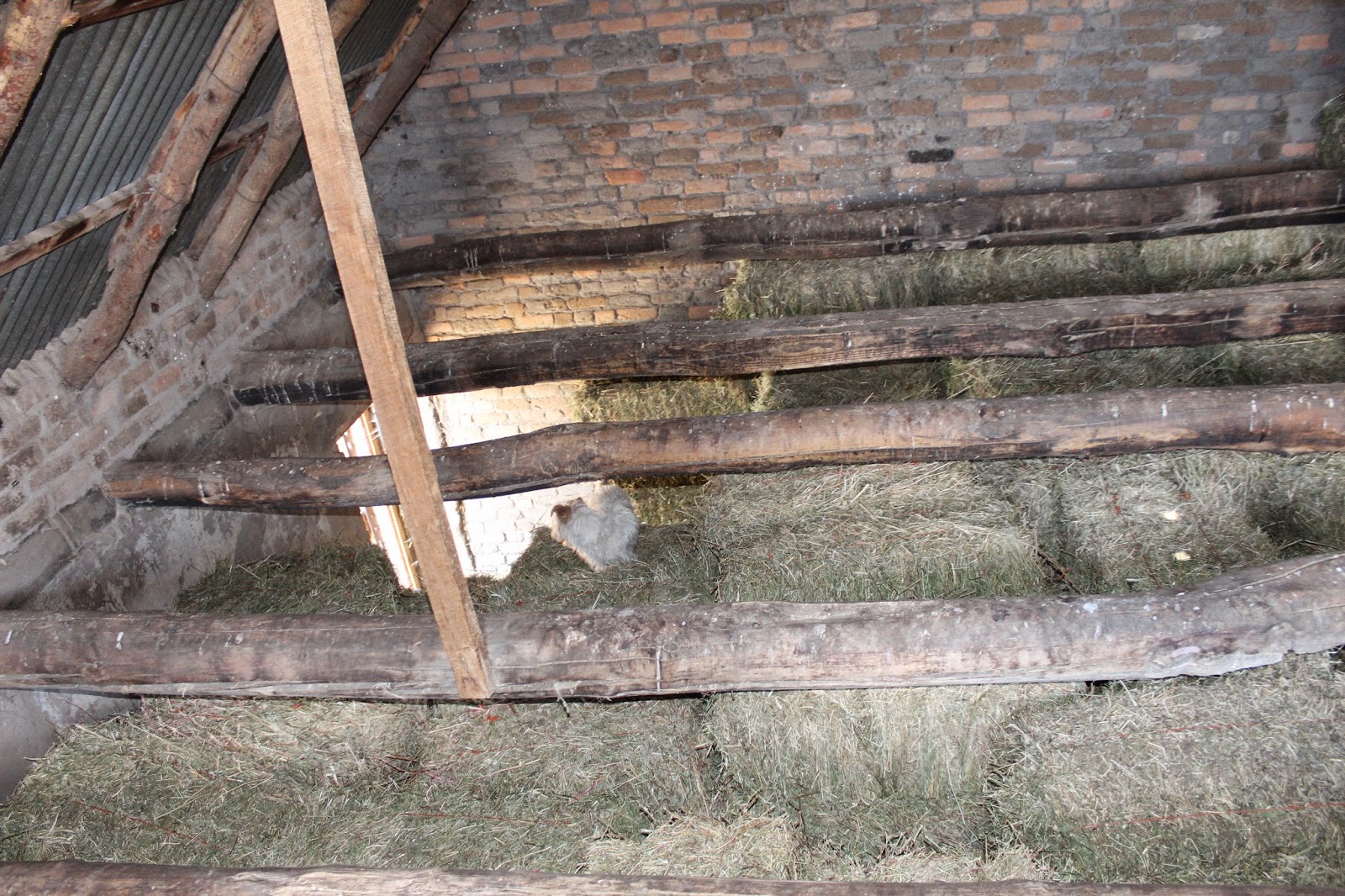
of lucerne hay. The bales were stacked right to the beams, and from there even
higher up into the roof space. We climbed up the tower of baled to the top
where there was a gable window from which we could look out across the farm.
“Those were poplar beams,” Malcolm told me. “But the amazing
thing is how they were joined.”

I followed his finger and then I saw it. I could not see a
single nail in the entire roof structure. Where the beams were joined, holes
had been drilled, with wooden pegs driven through. This had held the structure
securely together for perhaps a 150 years. Even now they showed no sign of
needing any maintenance. I was impressed. Something else which impressed me was
the fact that even though I looked carefully I saw no sign of wood borer
damage.

Malcolm explained that poplar timbers were useless outside,
but as long as you kept them dry they were unusually long-lasting and durable
for construction. Funny how these casual remarks from an older generation can
sometimes explain the things we see around us without questioning them. It
instantly made me understand why there were poplar groves across the entire
Karoo region.
In this largely treeless land, the pioneers had to build
homes which required timbers. Clearly they had learned that poplar was ideally
suited, being very hardy for surviving the droughts, baking summers and
freezing winters, and also being faster growers that would resist insect pests.
I was starting to be glad that I had allowed Malcom his initiative.

Next to me Willem was staring out the window. I smiled when
I considered him. He told me he was 15 years old. A townsboy from Queenstown
who was visiting for a farm holiday. His father had brought him for a hunt the
previous year, and he had quietly fallen in love with this wild and rugged
landscape. He told me he hoped that he could become a farmer one day. He seemed
an unlikely candidate with his spotlessly neat clothes, flawless white skin and
china blue eyes. And yet, there was something of the pioneer about him.

I think I saw it in the way that he looked out the window as
the sun was streaming through it, drawing long streaks in the floating dust. I
knew he saw something that afternoon. Perhaps it was just a dream that was
materializing. Or hope.

What do we see when we are 15? My world looked entirely
different at that age. Life did not have as many dimensions. Or maybe it had
more. Either way, I somewhat envied him his ability for still seeing like I
thought he did. At the same time I also pitied him, knowing that he would lose
it one day – just like we all do. It is one of life’s unappreciated gifts that
we don’t see the realities of the future for what they are while we are young. In
the meantime Willem was a pleasant curiosity. He spoke not a word of English,
but he could understand it easily. Malcolm mostly spoke English. There were
exceptions, though, when he wished to emphasize part of a story so that he
could be sure that Willem would understand. Then he would speak Afrikaans in
that peculiarly pleasant accent which is characteristic of the English farming
folk. He chose his words slowly and carefully, like someone who had a respect
for grammar, and who knew that words contain more meaning than dictionary might
suggest.

The dogs enjoyed the hay loft, jumping about and sniffing
into recesses for the scent of mice and rats. Malcolm then took us to a slight
rise just behind the old house. There he pointed to a very large circle of
stones.
“Willem, what do you think this is?” he asked the boy.
Willem squinted with concentration and then admitted that he
had no idea.

It was a threshing ground. Many modern people would have no
idea what this is. Such ignorance would have been unthinkable only 60 years ago.
The site looked as if it might have some bedrock that might have been covered
by sand and stones over time. Often such a threshing ground would be levelled
out with a slab that was plastered with a mixture of clay and cow dung. This is
also what the pioneers used as flooring in their homes. The mixture would be
dry, smooth, pleasant to the touch, warm beneath bare feet – and completely
odourless. There was nothing primitive about this ancient form of homemade
concrete.

I knew exactly how threshing worked, but somehow I enjoyed
it to hear Malcolm’s animated explanation to the lad. Threshing floors, he
said, were always built on a high rise so that they would be exposed to the
prevailing winds. Sheaves of wheat or grain would then be scattered across
evenly across the surface. A horse or some similar animal would then be lead in
circles across this carpet of grain. Gradually it would trample the stalks
until most of the grain would separate from their stalks. After a while the
farmer would then use hay forks to cast the stalks into the air. The grain
seeds, being heavy, would then fall to the ground, while the lighter chaff and
stalks would be blown away by the wind.
“The wind can’t be too weak,” Malcolm said, “and it cannot
be too strong. It must be just right.”

This is how grain was threshed since time immemorial. The
Bible speaks of the same practice several times. Our ancestors did it like
this, and in third world countries the practice still continues. Afterwards the
grain would be gathered into bags or baskets so that it could be stored or
perhaps sent to Chappy Scot’s old stone mill to be ground into flour.
The De Witt graves
I wondered about this De Witt family. De Witt is a
well-known Karoo family name. Malcolm drove down into the alluvial fields next
to the river to show us two old lonely graves. One gravestone was smashed to
pieces so that there was no inscription to read. The other was a cross which
was still intact. We cleared some branches and deciphered the Dutch inscription
which read:
Andries Johannes
Jacobus De Witt geboren den 27 Junie 1877 en ont slapen den 31 October 1897.
Ouderdom van slechts 20 jaren 4 maanden en 4 dagen. – “Andries Johannes
Jacobus De Witt, born the 27th June 1877 and deceased the 31st
October 1897. Age of only 20 years 4 months and 4 days.”

It seemed such a shame to me. At 20 life has barely started
for a country lad. You can tell how precious time is from how his age was
presented to the last day and month. Someone loved this young man. Someone
grieved for him. Someone used to tend his grave. And now he is unknown to
history. I wondered how he died? It could have been sickness, a fall from a
horse, snakebite or a Bushman arrow. In frontier times life was a gentle flame
that was always flickering before the draft of possible extinction.
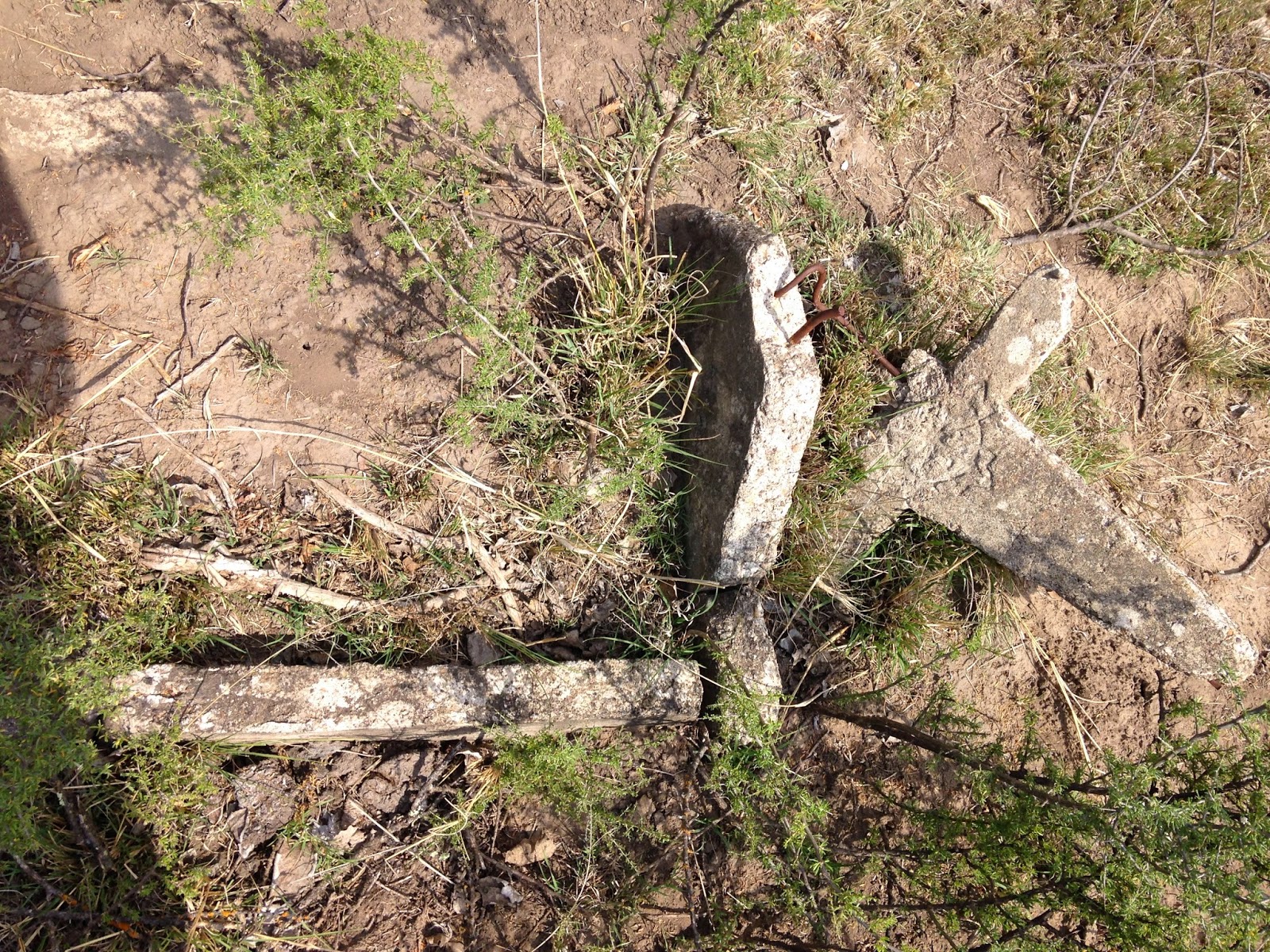
While we were pondering this, I noticed ant bear holes
around the graves and casually wondered why they often dug near graves. I would
soon know the answer, and I will share it later.

A Boer fighter who was buried
and ploughed under in the dead of night.
Meanwhile Malcolm drove to another part of the farm again.
He wanted to show me the original settler’s fields where grain and vegetables used
to be grown, but where he now plants alfalfa, or lucerne, as we call it in our
country. The fields used to be irrigated from a very long irrigation furrow
that had been dug by hand from far up the river so that the water could be fed
by gravity. Along the banks of the furrow the pioneers had planted fruit trees.
Although they were now extremely old, there were still a few gnarled quince trees,
figs, apples and some bottle pear trees which bore pears of a size that we no
longer see.

I could imagine that once upon a time it must have been a
bustling farm, full of the sounds of animals and children, with everyone
working together towards a common goal. Times have changed, however. Families
have grown small. Young people are drawn to the cities, droughts have drained
the energy of the original old souls who once lived there, and farmers have
been forced to convert to more profitable mechanised endeavours. Life was still
good, but I could see that in the process we had lost something. We had grown
further from our roots, to where they were less able to feed us properly.
It was in one of the fields, however, that there lay a piece
of history which Malcolm particularly wanted to share with me. During the
Anglo-Boer War of 1899-1902 he said, there had been a skirmish between the
Boers and the British higher up the farm. In the process one of the Boers was
wounded. Being too badly injured to travel, his companions brought him to the
De Witt farm so he could be nursed. This was a very dangerous thing to do, for
if they had been found aiding and abetting what the authorities considered to
be the enemy, they would have been severely punished.

Unfortunately the wounded fighter died that night. Perhaps
this really made things easier for the De Witts, except that now they had a new
problem. How to dispose of the body without being seen? At the time it was
common for farm labourers to be compulsive tale bearers, and everyone knew that
the story of a wounded Burgher would find its way to British ears. It was
subsequently decided that the man would be buried in the darkness of the night,
somewhere in the family’s field.
The next morning early, the labourers were given the day off
and told to go and enjoy themselves somewhere else. The farmer then took his
oxen and set about to plough the field. In this manner the lonely grave of a
Boer fighter became lost. Today the exact position of his grave remains unknown,
and no-one even has an idea what his name was. It is possible that only Malcolm
and his family knows the story, and if do not write it down, then in time it
will probably be lost to the history of man.

This, I thought, illustrates to me that there is value after
all in being what I consider myself to be sometimes – a minor league amateur historian
who has spent his life slowly recording microscopic pieces of history that
should ideally be preserved. They may not be of tremendous value, but I think
they are worth salvaging. Let the big league historians write about the major
battles and significant landmark events. I will pause to collect the little
pebbles – and try to tell something about ordinary lives from extraordinary
times.

Discovering the scene of an
ancient Voortrekker tragedy
From the fighter’s grave, we bade the old De Witt farm adieu
and headed up the road again. Malcolm was still not ready to go on to Hans
Bezuidenhout’s monument. He had something else that he was saving for me. On
the eastern side of the road, he finally turned in by a rusty farm gate.
Bumping and squeaking we drove into the veld across the stones and dry Karoo
bushes. We were heading for a delta-shaped valley that lay between the toes of
the mountains. He wanted to show me a piece of history that has, as far as we
know, never been recorded. It was the scene of a tremendous tragedy that has
almost entirely been forgotten.

At a spot where old abandoned fields finally surrendered to
rocky slope where the mountain starts to rise, Malcolm stopped the pickup and
we got out. He walked over to some scattered stones and pointed at them. The
story that he told was sad and frustratingly short, because the told people who
had known the full story had long since passed away. Yet, even though the
details have been lost, one cannot fail to be moved when one imagines what the
circumstances must have been like. It proved the discovery that I would
remember most about my entire journey.

During the time when Great Trek started, Malcolm said, the
Voortrekkers chose this very spot to outspan their waggons and let their
livestock graze. Little did they know it at the time, but this would mark the
spot where the angel of death would come harvesting their field. It started
when a dreadful plague broke out, as quietly as plagues invariably do. A rash
or a fever here, a flickering candle in a tent late at night over there, and a
family dressed in black in the morning. That’s how it must have begun.

They must have thought that it would be over soon, but they
were wrong. The sickness soon began to spread from tent to tent. Whether it was
smallpox or measles Malcolm doesn’t know for certain anymore. What is sure,
however, is that the effect was devastating.

The first casualties were buried somewhat lower down where
the soil was softer. Soon there was an entire row of graves, which ended where
a rocky patch made digging difficult. The pioneers started a second row. And
when that row was full, they started a third. So they kept on adding graves
until they were at the base of the mountain. That is where the dying must have
ended finally. It seemed poetically ironic that the dying stopped when the
earth became too hard to dig anymore.

It was difficult to identify the graves today, because
nature was reclaiming the last of the little piles of stones. Year after year,
for decades and generations, baboons have been turning all the stones that can
be moved along the mountain sides. This is what they do in their search of
scorpions, which is a delicacy that all baboons prize. Unfortunately this has
also had the effect of slowly destroying the graves.

Malcolm said that originally the rows could be seen more
clearly. He reckoned there used to be roughly a hundred graves per row – and
there had been more or less three rows. 300 people. I was not sure that there
would have been as many as that, but what does it matter? Life was precious on
the great frontier, and the border community could not afford to lose a single
one. 12 would have been a tragedy. 50 would have been disaster. And there were
more than 50 graves here. Perhaps, indeed, two or three hundred. One could not
help but feel touched by gentle evidence of whispering tragedy in this solitary
place.

I have visited a great many sad places in my life before. I’ve
been to very many cemeteries where thousands of people lie buried. I’ve seen
mummies in museums, foetuses in bottles, and military graves. This quiet and
forgotten place, however, seemed to me the saddest place that I had ever
visited. It made me want to sit down by one of the little piles, and press some
flowers into the soil. Just so that humanity might show that it still cared
about all the wasted human potential that was buried there. But it was dry
again, as it always seemed to be, and there were no flowers. All you can do is
stand and stare. Listen to the silence. And imagine that you hear the voices of
vanished people who once upon a time had been no different at all from you and
I.

I tried to imagine the dreadful trauma by imagining the
valley filled with tents and waggons and thousands of head of sheep and cattle
before my mind’s eye. The Voortrekkers had known death and fear for
generations. They were used to it to some extent. They must have been both sad
to leave their homes, and also excited at the great adventure that lay ahead.
They must have been looking forward to rebuilding new lives with more happiness
and dignity. That makes it to me all the more tragic to think that at the very
doors of leaving a dark past in search of a brighter future, they had to be
struck so dreadfully.

There was nothing that they could have done. Invisible germs
killed without discrimination. Folk remedies, mountain herbs and Dutch patent
medicine would have had no effect. There were no doctors, and even if there had
been, they could only have tried to make the patients comfortable until they
died. The pioneers could do nothing more than nurse their loved ones, bury them
when their breath went still, and sing their melancholy psalms when the angel
of death was done.

There were no inscriptions on the stones. The rock was too
hard to be carved. There was no time to import proper stones. It was not even
part of the custom of those times. Mothers and fathers simply prayed by the
graves of their loved ones, watered the bitter soil with their tears, and then
walked away into a brooding future. They would never see those little piles
again. They knew they had to leave them behind where they would be framed by
the golden hills and the blue sky. To be tended by the citizens of the
mountains until they were made level with the ground once more. They had to
leave the dead behind so that they living could find life ahead.

The Voortrekkers were cheerful people, though. They had to
be. The routes of their migrations were marked with graves in the wilderness.
If they did not have the faith of their religion and an ever-present sense of
humour, I don’t think they would have made it. Had they known that there would yet
be other acres of tragedy similar to this one – although not necessarily due to
disease – they might have turned around and gone back home again. Fortunately,
though, we do not know the ways of the future. And so, driven by the thirst for
freedom, and sheltered by ignorance of not knowing how much more suffering they
would encounter, they continued. Perhaps this doesn’t even count as bravery. Perhaps
they were just like we would have been. Following the road of life that seemed
to be the best at the time – mostly because it appeared to be the best out of a
range of bad alternatives.
The plough of God
Later, when I returned home again, I wrote a piece about an
ecological observation which we made near the graves and posted it on Facebook.
I thought I might share it here.
“In the Eastern Cape there is a region around the towering
Winterberg mountain, where you can vanish into a circular region of wilderness
valleys in a forgotten circle of loneliness where time has partly been
forgotten.
When my ancestors went on the Great Trek between 1836 and
1838 the British settlers who came in 1820 gradually took over the area, and
their descendants still farm the region to this day.
After I had nursed my car across the torturously bad tracks
that cross the Winterberg, I stopped at a beautiful 100 year old Victorian
sandstone farmhouse to ask directions. A friendly man named Malcolm Philips
came out to greet me. I was invited to lunch - and despite the fact that I had
other plans, he kept me there for the rest of the day. Such are country folk in
the faraway places of the world. They are somehow just more human than most.
Malcolm had with him a 15 year old boy named Willem Van der
Linde. He was a townsboy from Queenstown, but he and his father had hunted with
Malcolm in the past, and as he hoped to be a farmer one day, he had been sent
to spend the holiday in the Winterberg. Willem spoke Afrikaans and Malcolm
spoke English - just as the custom had been when my ancestors still lived there
in the 1820's.

While Malcolm was showing me some ancient graves, Willem
pointed to some patches of disturbed ground and wanted to know what caused
them.
Malcolm, who had grown up in the mountains, immediately
replied, "oh that is the plough of God."
I was mystified. I couldn't decide whether he was serious or
confused. I had never heard the expression before.
Then Malcolm explained. When it is dry, like now, the
baboons dig up large patches of grass, looking for grass and sedge roots to
eat. In the beginning he used to be annoyed at this disturbance of his grazing
and he used to shoot the baboons. But over time he came to realize that they
fulfilled a unique purpose which was very much in his favour.

When Malcolm inherited the land from his father, and bought
some adjacent portions, the farms had been severely overgrazed for many years.
Sheet erosion had meant the washing away of topsoil so that large patches had
become bare of vegetation, with the soil being hard and sterile just like
porcelain. Even where vegetation did grow, it was mostly confined to inedible
bushes and prickly grasses of low nutritional value.
Over the years, however, he noticed that whenever the
baboons dug up patches, the soil would remain loose and soft for a long time.
When grass seeds blew onto it, they worked their way into the ground where they
would germinate. When it rained, the water would soak in, instead of simply
running off. Malcolm showed us several patches where healthy stands of Themeda triandra - or Rooigras - had
become decidedly dominant on the digging patches of previous years. In this
manner, nature restores itself.

Willem was a contrast to the land. He was very fair-skilled
and looked like a typical city boy, whom I would have rather expected to see
with a skateboard under his arm at the mall, and out here in the perfect
wilderness. Yet, in the violet blueness of his eyes, I could tell that he saw
something in the dry and barren land which other did not. He had what I call
"seeing eyes." I have noticed eyes like that before. They see more
than just the world before them. They see into the past, and far beyond the
past into the future. In his dreams, I thought, he was walking on land such as
he would own himself one day.
I asked Willem if he knew that grass seeds drill into the
ground? At this, Malcolm became excited and tried his best to find some seeds
from last season. It is one of the wonders of the world that so few people know
about. Many grasses have seeds that have a sharp-tipped head, about half as big
as a match head. Attached to this would be a tail of up to the length of a
matchbox, which is often comprised of one or more thick and hairy strands.
These strands, when they become moist, rapidly twist and
turn. If you take a strand and moisten it in your mouth, you can see it twist
and curl before your very eyes. When dropped onto the ground, the seeds will
writhe and slowly bore their way deep into the ground. It is a miracle of
nature, and a beautiful element of design in the complex machinery that God
designed to keep the world alive and well.

Sharing the secrets of nature is one of the great privileges
of life. As we stood there upon the sun-baked plains, we were childlike in our
enthusiasm to share the knowledge with a new generation. I told Willem what I
knew, and Malcolm told him what he remembered. We were exchanging jewels of
country knowledge, not just with each other, but with ourselves that afternoon.
There was a sense of discovery, just in finding that we knew as fact that
things that the other explained to the listening youngster.
These were things my father taught me, which he had been
taught by his father, and his father's father. It was the same with Malcolm. We
were paying forward what we knew. We were letting nature speak with human
voices. Willem didn't say much, but he listened with close attention to every
word. Perhaps, if time and opportunity directed it this way, he would be
telling his own children what he had learned from two nostalgic fuddy-duddies
on a sunny afternoon one day.

It has taken Malcolm 30 years to restore his farms, and
still the job is not complete. When the first bulldozers arrived in 1957, his
predecessor had spent a thousand pounds to create a contour in this one valley
alone, so that the water would not wash the soil away so fast. My father always
told me, you can destroy the land in just a few short years, but it will take
you 20 years or more to build it up again. And that was in the sour veld, which
recovers far more quickly than here in these sweet veld parts. I told Malcolm
this, and he agreed. The job of restoration would probably take until both of
us are dead one day.
When we drove homeward late that afternoon, we were tired,
thirsty and slightly sunburnt. I asked Willem if Malcolm's Labrador was going
to ride back on the pickup.
"No, she's too fat," he said.
She would have to jog home, the way she came.
I smiled. Everything made me smile out here. I saw myself in
Willem. I saw the future in him. I also saw myself in Malcolm, and recognized
between us something that there used to be between my father and I. They were
the same age, incidentally, Malcolm and my dad. Life brings you there,
eventually. When 15 year olds start calling you "uncle," according to
country custom, and when you start realizing that you must share what your
father taught you, so that the world would have a future. Malcolm and I
understood that. One day Willem will understand it too.”


